Avery Klein · 14 November 2026
Former University Researcher Redirects Efforts Toward Building Local Knowledge Networks for Climate Adaptation Strategies in Agricultural Zones
Former university researchers have shifted focus from academic institutions to community-based initiatives that connect farmers with localized climate data and adaptation practices across agricultural zones worldwide, and this transition reflects broader patterns in how expertise moves from formal research settings into practical applications. Studies from multiple regions show that such networks help integrate traditional farming knowledge with recent climate projections, creating systems that support crop resilience without relying solely on centralized models.
Background on the Researcher's Transition
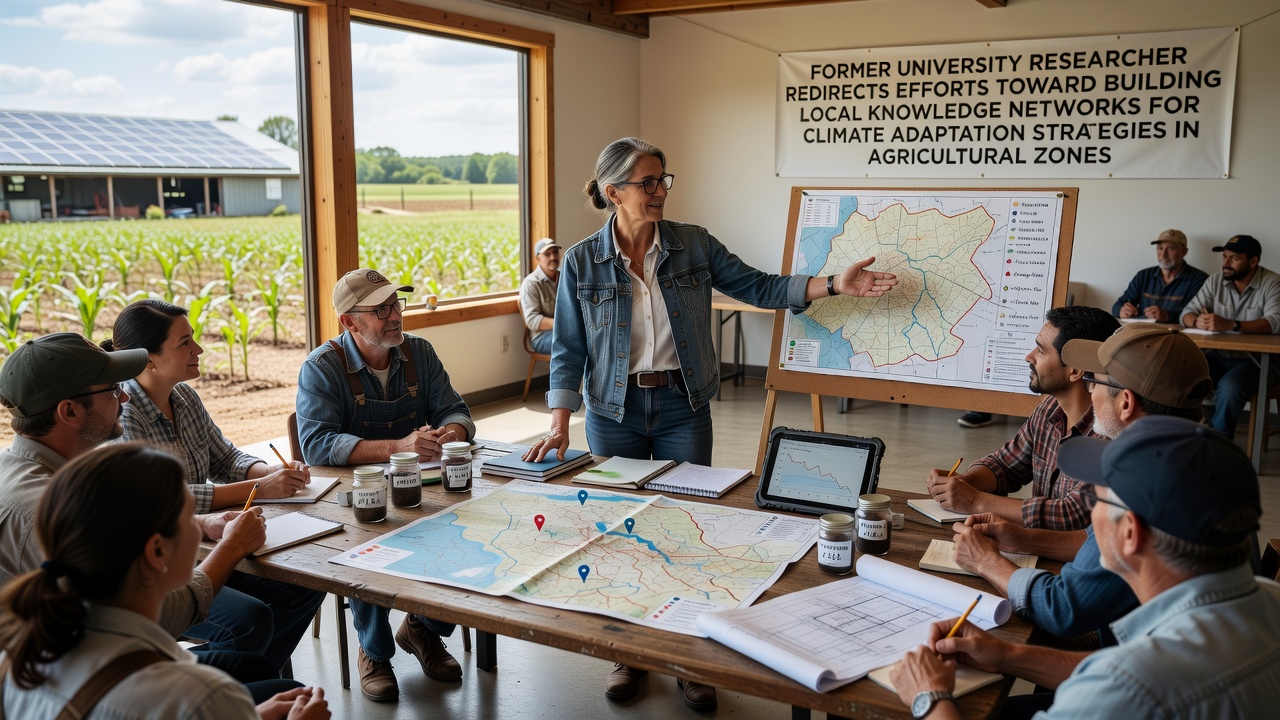
Data collected by agricultural organizations indicates that many experts who once held positions at universities now coordinate regional groups where farmers exchange observations on weather patterns, soil changes, and crop responses. One individual who left a university role in 2023 began organizing workshops in several mid-latitude farming districts, and these sessions combine satellite imagery with on-ground records that participants maintain themselves. Figures from the Food and Agriculture Organization reveal that similar efforts have expanded in at least twelve countries since 2024, with participation rates rising steadily through coordinated meetings held every quarter.
Those who've examined the structure note that the networks operate through shared digital platforms and in-person gatherings, where contributors upload field notes that others can access for seasonal planning. Research indicates that this approach reduces duplication of effort because participants build on collective findings rather than starting from isolated experiments each cycle.
Climate Adaptation Strategies in Agricultural Zones
Agricultural zones face documented shifts in precipitation and temperature ranges that affect planting schedules and yield stability, according to reports compiled by national meteorological services. The networks address these changes by mapping microclimates within larger districts, allowing farmers to select varieties suited to specific conditions rather than broad regional averages. Evidence from field trials coordinated through these groups shows adjustments in irrigation timing and cover crop selection that align with updated forecasts released in late 2025.

Observers note that integration of indigenous practices with modern monitoring tools forms a core element of the strategy, and case examples from zones in both hemispheres demonstrate how this combination supports soil moisture retention during extended dry periods. Data compiled in November 2026 by regional agricultural departments recorded a measurable uptick in adoption of these combined methods across participating zones, with follow-up surveys tracking implementation rates over multiple growing seasons.
Structure and Operations of Knowledge Networks
Local knowledge networks function through decentralized nodes where trained facilitators guide discussions and compile aggregated results for wider distribution, and this model avoids the bottlenecks common in top-down extension services. Participants contribute data on pest outbreaks, nutrient levels, and variety performance, which gets cross-referenced against climate datasets from government agencies. The approach draws on principles established in earlier participatory research programs, yet it emphasizes ongoing local ownership over time-limited projects funded by external grants.
Experts have observed that digital tools play a supporting role, enabling real-time sharing of observations while preserving the value of direct conversation during seasonal reviews. Figures released by the European Environment Agency highlight parallel developments in several member states, where similar networks link smallholder operations with larger commercial farms to exchange adaptation tactics tested under comparable conditions.
Geographic Expansion and Measured Outcomes
Expansion has occurred in zones across North America, parts of Africa, and Southeast Asia, with each region adapting the core framework to local governance structures and crop types. Research indicates that zones with established networks report faster dissemination of successful practices compared to areas relying only on conventional advisory systems. One documented instance involved a network in an arid agricultural belt that coordinated seed exchanges based on drought tolerance data gathered over two prior seasons, resulting in coordinated planting adjustments ahead of forecasted variability.
Statistics gathered through ongoing monitoring programs show participation growth from several hundred individuals in early 2024 to several thousand by mid-2026, and this increase correlates with the establishment of additional regional hubs. Those coordinating the networks maintain records of outcomes such as reduced crop loss percentages during weather events, though attribution remains complex because multiple factors influence final yields.
Challenges Encountered During Implementation
Implementation faces hurdles related to data standardization across different recording methods and varying levels of technological access in rural areas. Network organizers address these issues by providing training modules that accommodate both paper-based and digital input formats, ensuring broader inclusion. Reports from participating zones indicate that trust-building requires consistent follow-through on shared recommendations, and groups that maintain transparent decision processes tend to sustain higher engagement levels over successive seasons.
Conclusion
The redirection of expertise from university settings into local knowledge networks represents one documented pathway for advancing climate adaptation in agricultural zones, supported by measurable participation trends and regional outcome data collected through 2026. Continued tracking by agricultural research bodies will provide further insight into long-term effectiveness across diverse growing conditions.