Avery Klein · 3 October 2026
Former Finance Analysts Launch Worker-Owned Solar Cooperatives Across Depopulated Mining Regions
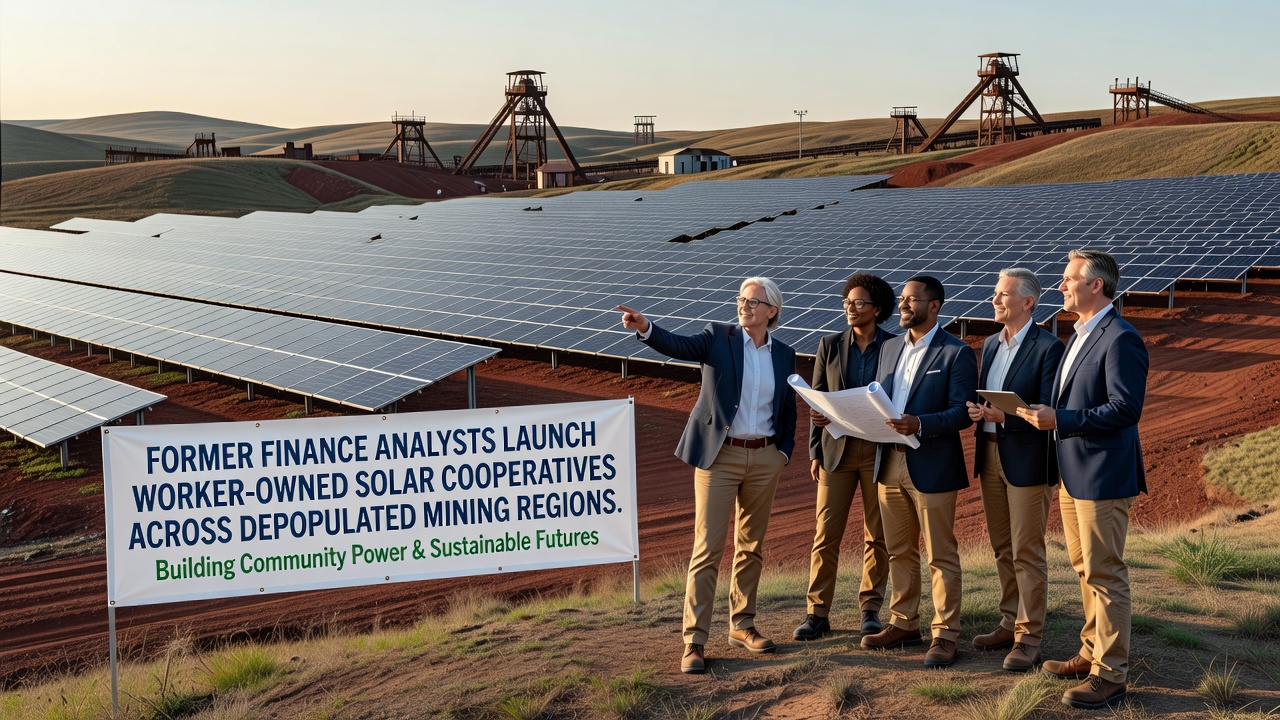
Former finance analysts have begun establishing worker-owned solar cooperatives in regions once dominated by coal and mineral extraction, where populations have declined sharply over recent decades. These initiatives convert abandoned mine sites and surrounding lands into renewable energy installations that distribute ownership stakes among local participants rather than external investors. Data from multiple transition programs show such models emerging in parts of Appalachia, the Canadian prairies, and Australian outback communities since the early 2020s.
Observers note that the shift draws on skills analysts developed in risk assessment and capital allocation, now applied to project financing for photovoltaic arrays and battery storage. In October 2026 several cooperatives reported completing their first full year of grid-connected generation, with output figures tracked through regional utility filings.
Background on Depopulated Mining Regions
Mining communities experienced sustained out-migration as extraction activities scaled back, leaving behind infrastructure that requires remediation before alternative uses become viable. Government records indicate population losses exceeding 20 percent in select counties of West Virginia and Alberta between 2010 and 2025, while similar patterns appeared in parts of Queensland. Environmental assessments document legacy contamination that solar developers must address through soil stabilization and water management protocols prior to panel deployment.
Researchers at the National Renewable Energy Laboratory documented how former mine lands often possess flat terrain and existing transmission corridors, reducing interconnection costs compared with greenfield sites. These physical characteristics have attracted interest from groups seeking to pair remediation funding with renewable generation targets.
Analyst Backgrounds and Cooperative Structure
Individuals who previously worked at investment banks and asset management firms formed the initial organizing teams. Their experience with financial modeling supports applications for federal and provincial grants aimed at just-transition programs. Worker ownership takes the form of membership shares that entitle participants to voting rights on project decisions and proportional distributions of net revenues after operating expenses.
Legal frameworks in the United States and Canada permit such entities to register as cooperatives under state or provincial statutes, which can qualify them for tax treatment distinct from standard corporations. In practice, members contribute labor during construction phases and later handle maintenance or community education tasks, while professional technicians manage day-to-day generation operations under contract.
Implementation Steps and Regional Examples
Project timelines typically begin with feasibility studies that incorporate geological surveys and grid capacity analyses. Once permits clear, cooperatives secure financing through a combination of member equity, low-interest loans from development banks, and production tax credits available under existing renewable statutes. Construction crews then install fixed-tilt or single-axis tracking systems sized to local demand and export capacity.
One cooperative in eastern Kentucky connected a 15-megawatt array to the regional grid in mid-2026, while a parallel effort in Saskatchewan reached commercial operation with a 22-megawatt facility the following month. Australian groups operating near former coal basins reported comparable scale projects entering service during the same period. Revenue streams derive primarily from power purchase agreements with utilities plus sales of renewable energy certificates.
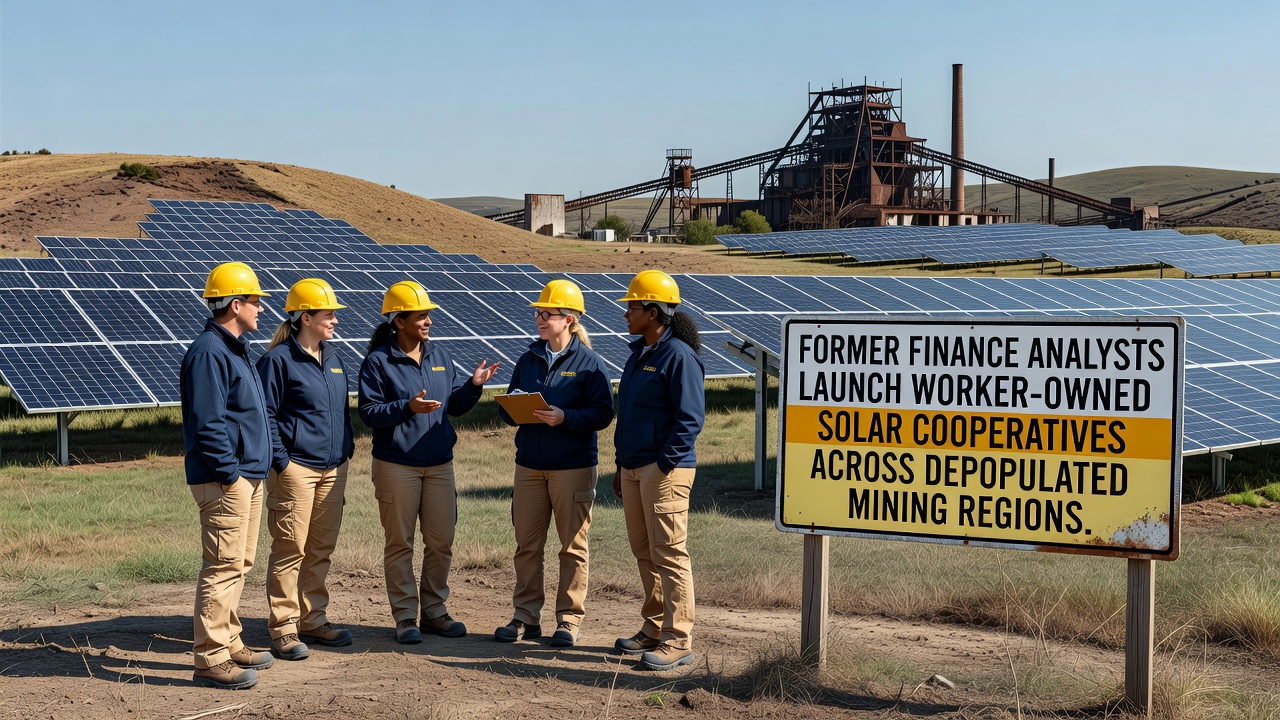
Training programs developed in partnership with technical colleges prepare residents for roles in electrical work, vegetation management, and performance monitoring. Participation rates among former miners and their families have increased as word of stable income opportunities spreads through local networks.
Economic and Environmental Outcomes
Employment data compiled by state labor departments show that participating cooperatives created an average of 12 full-time equivalent positions per megawatt installed during the first two years of operation. Wage levels align with prevailing rates for solar technicians in each jurisdiction, supplemented by profit-sharing distributions that vary with annual generation and market prices.
Environmental monitoring conducted by independent consultants indicates measurable reductions in site erosion once vegetative cover is reestablished around panel foundations. Carbon accounting methodologies applied by academic teams attribute avoided emissions to displaced fossil generation, although exact figures depend on the marginal power sources in each balancing authority area. Water usage for panel cleaning remains minimal in most designs, relying on rainfall supplemented by periodic dry-brush methods.
Challenges Encountered and Mitigation Approaches
Initial capital requirements remain substantial despite grant support, leading some groups to phase construction across multiple funding cycles. Interconnection queues at transmission operators have extended timelines in high-demand regions, prompting cooperatives to explore behind-the-meter applications such as agricultural processing loads. Community engagement processes address concerns about visual impacts and land-use changes through site visits and transparent decision records.
Insurance markets have adapted products to cover cooperative-owned assets, though premiums reflect the novel ownership structure and remote locations. Ongoing technical assistance from university extension services helps members navigate regulatory filings and performance optimization.
Outlook for Continued Expansion
Policy developments at both national and subnational levels continue to shape available incentives. Analysts tracking legislative calendars note that several jurisdictions extended or expanded tax credit provisions through 2030, providing longer planning horizons for new entrants. International comparisons published by research organizations highlight similar worker-owned models operating successfully in parts of northern Europe, offering templates that can be adapted to North American and Australian regulatory contexts.
Coordination among cooperatives through regional associations facilitates knowledge sharing on equipment procurement and grid integration practices. As more projects reach commercial operation, aggregate generation data will become available for broader studies of land-use transitions in former mining districts.
Conclusion
Worker-owned solar cooperatives represent one mechanism through which former finance professionals and local residents jointly address economic contraction in mining regions. Documented installations demonstrate technical feasibility and measurable employment effects, while ongoing monitoring tracks environmental metrics. Continued participation depends on sustained access to financing tools, streamlined permitting, and reliable revenue from electricity markets.